
At approximately 2:31 a.m. on February 16, 2026, Caleb Flynn called 911 from his family home in Tipp City, Ohio, a small community north of Dayton. His wife, Ashley, had been shot. He told the dispatcher that someone had broken into the house. Their two daughters were asleep upstairs.
Officers arrived within minutes. There was a damaged garage door, an open compartment in Caleb's truck, and a distraught husband who said he had discovered an intruder's violence in the middle of the night. Ashley, 37, was dead in the couple's bedroom.
The case seemed, at first, to be a nightmare home invasion. But there was a problem with the story: investigators could not find convincing evidence that a stranger had entered the home. And as they examined the family's relationships, electronic records, and the physical scene, they discovered another story altogether—one that Caleb had been discussing privately for months.
Seven months later, on September 29, 2026, a Miami County jury found Flynn guilty of aggravated murder and related offenses. On October 5, a judge sentenced him to life in prison without parole, together with additional consecutive prison terms. He continued to insist he was innocent. (ABC News: sentencing; Court TV: trial coverage)
What made the case nationally recognizable was Caleb's past: he had been a music pastor, a church worship leader, and a contestant on the 2013 season of American Idol. What ultimately mattered in court, however, was not the contrast between his public image and the verdict. It was the evidence of what happened inside an ordinary house—and the life Ashley Flynn was no longer there to live.

Ashley Elizabeth Flynn, photographed before her death. Portrait published by Frings and Bayliff Funeral Home with her family's obituary and remembrance. Image rights belong to their respective owner; publication permission should be confirmed.
Ashley Flynn: the life beyond the case
Ashley Elizabeth Flynn was born February 24, 1988. She grew up in the Tipp City area, graduated from Tipp City High School in 2006, and earned a degree from Lee University in 2010. She returned to a community where family ties, school activities, and church life would become central to her adult years.
Ashley taught with LifeWise Academy, worked as a substitute teacher, and coached seventh-grade volleyball. She volunteered at Christian Life Center, the church closely connected to the family. Her obituary describes a woman devoted to her daughters, her faith, and helping other people. Those who knew her remembered her encouragement and the way she made people feel seen. (Frings and Bayliff Funeral Home: Ashley Flynn obituary; Biography: Ashley Flynn's life)
Her family included her parents, Todd and Jill Smith, her sister Kayla Keyt, and a wide circle of relatives. Her husband worked in a business connected to her family, so relationships that were private, professional, and spiritual overlapped. Ashley and Caleb had been married for roughly fifteen years and were raising two daughters. Public coverage has often emphasized the children; their privacy, however, deserves more care than the spectacle of a criminal proceeding sometimes allows.
The family's religious life was genuine and visible. Ashley did not merely attend church: she volunteered, taught, and raised her children within that community. It is important not to use her faith as a convenient irony in a story about her husband's crimes. It was part of her identity and service, independent of what he later did.
At sentencing, relatives described the devastating absence Ashley left in the children's lives. In their statement after the verdict, the family insisted that the violence ending her life would not be permitted to define the whole of her story. (ABC News: family statements)
Caleb Flynn: church music, television, and a respected public life
Caleb Flynn, born in May 1986, was 40 at the time of his trial. Reliable public accounts offer comparatively little about his early childhood, and there is no reason to fill that gap with assumptions. What is documented is his adult career in music, ministry, and sales.
Like Ashley, he attended Lee University. In 2013, he appeared on *season 12 of American Idol**, after auditioning in Chicago. A short television feature showed him speaking enthusiastically about singing and crediting Ashley for encouraging his ambition. He progressed only through the early stages of the competition; he was not one of that season's finalists. Describing him simply as an American Idol contestant* is accurate, but it can create an exaggerated impression of celebrity. (Biography: Caleb Flynn's background; Court TV: trial overview)
In later years, Flynn remained involved in church music. At Christian Life Center, lead pastor Jordan Hansen testified, Caleb served as a volunteer and contracted worship leader. The distinction matters: although he was widely described in headlines as a former pastor, his precise church role at the time of the killing was not necessarily that of a full-time ordained or senior pastor.
He also worked in sales for Richard D. Smith & Sons, Ashley's family-linked business, which supplied commercial flooring and seating. Publicly, he had a home, a career, two children, a marriage of many years, and a place in a prominent faith community. According to trial testimony, the business offered substantial future earning prospects. These circumstances became relevant not because a successful-looking life disproves marital trouble, but because prosecutors argued that Caleb wanted to keep its advantages while escaping the marriage. (Court TV: family-business and church testimony; ABC News: closing arguments)
The television clip from 2013 became haunting after the verdict. But old footage is not a diagnostic tool. Viewers cannot infer a future murder from how a man speaks about his wife in front of a camera. The discrepancy between public affection and private conduct becomes meaningful only in light of the later, documented record.
Alleigha Botner and a relationship kept secret
Among the central witnesses was Alleigha Botner, who had worked in the same church community. She testified that she met Caleb in 2022 while serving as an intern and that their relationship became sexual in 2024, while he was married. Their affair continued amid repeated arguments about when—and whether—he would leave Ashley.
Botner was in her twenties when she testified in September 2026. She said the two discussed a future together. She also described repeated promises of separation, shifting deadlines, deleted communications, and efforts to keep their relationship hidden from others. The relationship crossed the boundary between a private affair and evidence of a possible motive when investigators recovered extensive records of how Caleb spoke about Ashley. (ABC News: Botner's testimony; Associated Press: trial reporting)
A forensic examination uncovered more than 100,000 messages exchanged between Caleb and Botner over the period investigated. Not all of those messages were threatening. Most were part of a long and private correspondence. But the prosecution drew attention to messages in which Caleb wrote about his resentment and imagined killing his wife. In one May 2025 exchange, he said that if he could kill Ashley without going to hell, he would do so. In another message, he described staying awake trying to think of ways to kill her without going to prison.
These were not remarks someone merely claimed he had made years later: messages attributed to him were introduced at trial, and Botner testified about them. Their evidentiary significance was sharpened by a series of deadlines for separation and by messages sent just before the killing. (Court TV: messages and forensic testimony; The Guardian: September 2026 testimony)
Botner also admitted she had initially lied to the FBI about aspects of their relationship to protect her reputation. That admission gave the defense material with which to challenge her reliability. She was a significant witness, but she was not convicted of participating in Ashley's murder. Being the person involved in the affair, or making objectionable comments in private messages, is not the same as being proved an accomplice. She reportedly resigned from Christian Life Center after Ashley's death. The published record does not establish that she knew a murder would take place. (Court TV: testimony of Botner and Pastor Hansen)
The final weekend
In the days immediately before Ashley's death, the marriage was strained. Investigators later recovered messages from Ashley's phone showing frustration with Caleb's emotional distance and the couple's arrangements around Valentine's Day. The record did not establish that she knew he was about to kill her. It did show that a marriage which looked stable from outside was experiencing considerable tension. (Court TV: testimony about recovered phone messages)
On February 15, 2026, Caleb was communicating with Botner about decisions to be made and the future of their relationship. Prosecutors highlighted a message signaling that action would begin the next day. The defense argued that these exchanges concerned divorce and separation—not murder. This ambiguity is worth keeping in view: an individual message can have multiple possible meanings until it is examined alongside the broader evidence.
Hours later, early on February 16, Ashley was shot in her bed.
The prosecution's reconstruction was that Caleb killed her while she slept and then altered the property to suggest a break-in. The state did not present an eyewitness who watched the shooting, and the murder weapon was never recovered. What it presented was a combination of physical findings, digital records, communications, and apparent contradictions in the claimed intrusion. Ultimately, the jury accepted that case beyond a reasonable doubt. (Associated Press: the case at trial; ABC News: verdict and evidence)
February 16, 2:31 a.m.: the call that began the investigation
Caleb told emergency dispatchers someone had broken into the house and shot Ashley. He said he had been asleep and that he had awakened to a frightening disturbance. Officers responded to the home on Cunningham Court. Their first task was to make sure the danger had passed and to check on Ashley and the sleeping children.
They found Ashley in the bedroom. The two spent cartridge casings were consistent with a 9 mm firearm. A handgun Caleb said he ordinarily kept in his truck was missing, and the vehicle's storage compartments were open. The gun itself was never found, so investigators could not definitively match the casings to a recovered firearm. (Court TV: first responders and firearms evidence)
The side door of the garage appeared damaged. To someone seeing the house for the first time, damage to a door might suggest forced entry. Crime-scene investigators, however, looked at the direction and character of the damage. They described wood fragments and features inconsistent with someone forcing their way in from outside. There were no convincing tool marks showing the door had been pried open, and the deadbolt mechanism remained functional.
Police also canvassed neighboring houses. Security cameras did not show a person approaching the property in the relevant time window. At least one neighbor's motion-detecting cameras and dogs registered no unusual disturbance. None of these observations by itself proved that an intruder was impossible. Collectively, they made Caleb's explanation increasingly hard to reconcile with the scene. (Court TV: BCI crime-scene analysis and neighbor testimony)
Ashley's parents responded to the tragedy almost immediately. Jill Smith testified that Caleb called her in the early hours and told her someone had broken in and killed her daughter. She went to the house, where Caleb embraced her. Ashley's father, Todd Smith, later described his concerns about the supposed intruder story—including why the household dogs had not reacted. Family members were not forensic experts; their testimony mattered in showing how Caleb presented events to the people closest to Ashley and how those people began to question the account. (Court TV: testimony of Jill and Todd Smith; People: Todd Smith's testimony)
What investigators found—and what they did not
The Tipp City Police Department led the investigation, assisted by state and federal specialists. Detective Sergeant Mike Morgan handled important interviews. Ohio Bureau of Criminal Investigation agents examined the scene, and FBI specialists helped recover and interpret electronic information.
Their work unfolded along several overlapping lines rather than hinging on one dramatic revelation.
The garage door
State investigators testified that the damaged door did not fit an ordinary forced-entry scenario. The prosecution argued the marks were staged from inside the garage. This mattered because a real intruder was central to Caleb's explanation of the crime. If the entry point had been manufactured, the supposed burglary ceased to be an innocent assumption.
The weapon and physical evidence
Two cartridge casings came from the same 9 mm firearm, according to firearms testimony, but no murder weapon was recovered. Technicians examined fingerprints and DNA. Caleb's prints or DNA at parts of his own house and vehicle were unsurprising; the question was whether these findings, considered in context, supported the staging theory. Investigators did not identify a convincing foreign DNA profile connecting an unknown intruder to the crime.
The defense stressed important limitations: officers did not recover Ashley's blood on Caleb's clothing, and no gunshot-residue test was performed on him. The jury had to weigh those gaps honestly against the rest of the evidence. No single fingerprint, DNA finding, or missing test established guilt on its own. (Court TV: physical evidence and defense cross-examination)
Cameras, phones, and wearable devices
Investigators collected data from household cameras, phones, an Apple Watch, and other connected devices. Forensic analysts examined changes in device activity and recovered communications that had been deleted or concealed. The state's case included testimony that Caleb's watch registered activity before the emergency call, including 21 steps between 1:52 and 1:56 a.m. and 105 steps between 2:18 and 2:28 a.m. The 911 call came at about 2:31 a.m. (WLWT: digital evidence at trial; Court TV: Apple-device testimony)
Prosecutors used this sequence to test Caleb's account of sleeping and waking. The defense rightly noted that wearables are imperfect: they infer motion and sometimes misclassify it. A step count cannot tell an investigator what a person was doing in a particular room. The strength of digital evidence in this case came from comparison, not magic—from putting device activity alongside interviews, message timestamps, camera records, and physical observations.
The messages
The correspondence with Botner supplied the prosecution's most direct evidence of Caleb's expressed hostility toward Ashley. Forensic analyst Samantha Reeb discussed tens of thousands of exchanges, including numerous references to wanting Ashley gone or dead. Other investigators presented the devices and account records used to reconstruct the correspondence. These records could be examined by the defense, challenged at trial, and considered by jurors alongside the testimony of the people who had written or received them. (Court TV: analysts Samantha Reeb and Joseph Wilhelm)
The investigation also considered other possibilities, including a tip involving a possible hired killing; the FBI witness said that lead was not substantiated. Investigating an alternative theory is different from finding evidence for it. The state pursued the intruder narrative and other leads, but the case presented to the jury centered on Caleb.
An image the public recognized—and a record the jury had to judge
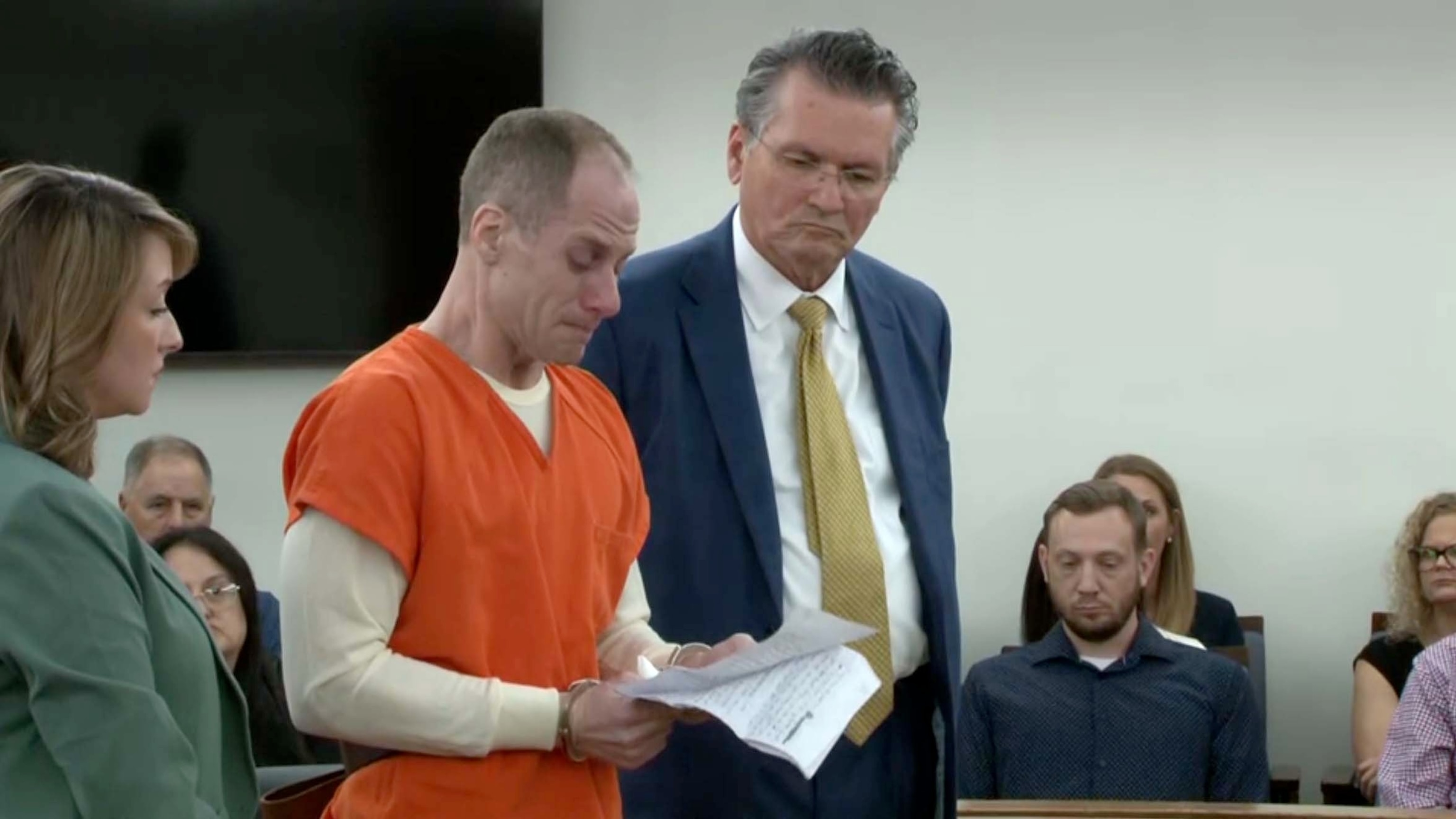
Caleb Flynn at the October 5, 2026, sentencing hearing in Troy, Ohio. Courtroom image credited to the pool via ABC News. Editorial image reuse requires an appropriate license or permission.
The case attracted coverage beyond southwestern Ohio because the man accused of murdering a teacher and mother had once spoken warmly about her on national television. Clips of his American Idol appearance circulated again. Commentators contrasted his music-ministry work with the revelations about his private life.
There is a danger in letting that contrast become the whole story. It makes for an arresting headline, but it can obscure what a criminal jury was actually asked to decide. Caleb was not prosecuted for hypocrisy, infidelity, or failing to meet the expectations of a church community. He was prosecuted for Ashley Flynn's murder and for alleged efforts to disguise it. The messages were important because they contributed to the state's theory of motive and planning, not because adultery is itself evidence of homicide.
The people who knew the couple had to confront two realities: a familiar person stood accused of a terrible crime, and a woman they had known as a teacher, volunteer, daughter, sister, and mother was gone. The trial made both realities public, but they were never equivalent. Ashley's life should not be reduced to a dramatic contrast with her husband's television appearance.
The trial: two interpretations of the same evidence
Jury selection began in September 2026, and opening statements followed on September 18 in the Miami County Court of Common Pleas in Troy, before Judge Jeannine Pratt. Jurors visited the Flynn house and saw photographs, recorded interviews, body-camera evidence, and extensive digital records.
Prosecutor Paul Watkins and assistant prosecutor Matthew Joseph argued that Caleb's attack was planned and that the burglary scene was manufactured to preserve the appearance of an innocent, grieving husband. According to their theory, he wanted a relationship with Botner while keeping his daughters, his professional prospects, his church standing, and possibly the financial benefits associated with Ashley's death. These were prosecution claims about motive, not direct access to Caleb's thoughts. (ABC News: prosecution's closing argument)
Defense lawyers L. Patrick Mulligan and Emily Smith countered that the state had built an accusation from circumstantial evidence after learning of the affair. They emphasized the absent murder weapon, the lack of a witness to the shooting, inconclusive forensic findings, and the possibility that investigators had interpreted ambiguous data in the light most damaging to their client. Smith acknowledged that Caleb had betrayed Ashley in the marriage but argued that being unfaithful was not proof of murder. (Court TV: opening statements and testimony; Associated Press: trial)
It was an important legal distinction. Circumstantial evidence is still evidence: criminal convictions can rest on it when the totality satisfies the requirement of proof beyond a reasonable doubt. But jurors must not treat an accusation, an ugly message, or an unhappy marriage as a shortcut to guilt. Here, they were asked to consider whether separate facts converged on a coherent account or merely appeared suspicious when arranged by prosecutors.
Botner testified over two days, acknowledging the affair, reading from messages, and facing questions about her own conduct and earlier lies. Officers and forensic experts explained the door, the neighborhood canvass, electronic records, and physical items collected. Ashley's family members described their relationships with Caleb and their response to his account of the shooting.
Caleb did not testify in his own defense. The defense called no witnesses after the state rested. Neither fact is evidence of guilt: an accused person is not required to take the stand or present a competing case. The prosecution must prove its charges.
On September 29, after a little more than two hours of deliberation, the jury found Flynn guilty on all nine counts submitted to it, including aggravated murder, murder, felonious assault, and tampering with evidence. The verdict rejected the defense's account and established his legal responsibility for Ashley's death, subject to the ordinary rights of appeal. (CBS News: verdict; Court TV: verdict and deliberations)
October 5: the sentence
The sentencing hearing was an occasion not only for punishment, but for Ashley's family to describe the consequences of her loss. The court received more than a dozen victim-impact statements. Her relatives spoke about the girls growing up without their mother and about the absence that would continue through milestones Ashley would never see. One of the daughters' statements challenged Caleb to accept responsibility. It is unnecessary to repeat every line of a child's grief to understand its force. (ABC News: sentencing and victim-impact statements)
Ashley’s parents said they had forgiven Caleb in a religious and personal sense, while still urging the maximum lawful sentence. Their forgiveness was not a request for leniency. As they explained through their statements, they did not want hatred to define Ashley's legacy. (Associated Press: sentencing)
Caleb read a prepared statement, addressed family members, and maintained that he had not killed his wife. He expressed sorrow for what his children were experiencing and asked the court to consider his position. His denial did not change the verdict.
Judge Jeannine Pratt imposed life imprisonment without the possibility of parole on the aggravated-murder conviction. She added 16 years of consecutive prison time arising from firearm specifications and tampering counts, to be served in addition to the life sentence. Other overlapping counts were merged for sentencing purposes. Pratt sharply criticized what she described as the deception and cruelty established in the trial. (WHIO: sentence structure; ABC News: Judge Pratt's remarks)
There was no separate sentencing for Ashley's daughters: they survived the crime and became, in another sense, among those most deeply harmed by it.
After the verdict: Ashley's family and the children
Ashley's relatives faced the practical and emotional work of caring for her daughters while the criminal case became a national story. Court records discussed in subsequent reporting identified Kayla and Matthew Keyt, Ashley's sister and brother-in-law, as co-interim emergency custodians of the children. That is a reported legal designation, not a claim about a final permanent custody arrangement. (WHIO: November 11 insurance case)
Her parents and sister testified publicly, but the children's later daily lives are not properly open for inspection simply because their family endured a widely covered crime. Their statements and custody circumstances are relevant to the public record; their school routines, home details, and private recovery are not necessary parts of a true-crime narrative.
For Alleigha Botner, the trial was also a public reckoning. Her relationship with Caleb, the extensive messaging history, and her admission of initial dishonesty were exposed in court. Her resignation from the church was reported in testimony. There is no verified basis in the sources reviewed to claim that she has been charged with Ashley's killing or that investigators established her participation in its planning. (Court TV: Botner testimony and church evidence)
The broader Tipp City community lost a teacher, a coach, and a volunteer. The family asked that, rather than making their private grief a public spectacle, people remember Ashley through words of encouragement, acts of kindness, and the work she had valued. Her obituary directed those wishing to make donations toward LifeWise Academy of Tipp City. (Ashley's obituary)
October–November 2026: prison, an appeal, and a new financial dispute
The legal story did not end at sentencing. The weeks afterward brought three verifiable developments: Flynn entered Ohio state prison custody, began an appeal, and became a central figure in a dispute over a life-insurance payout.
Where is Caleb Flynn serving his sentence?
Court authorities ordered his transfer from Miami County custody into the Ohio Department of Rehabilitation and Correction system in early October. By October 23, local reporting placed him at Toledo Correctional Institution. The state's official offender listing identifies him as incarcerated, records an admission date of October 7, 2026, and lists an aggregate sentence of life without parole. (WHIO: transfer and placement)
That answers where his sentence has begun, but not what an ordinary day inside prison is like for him. As of this article's November 13, 2026 publication date, reliable public reporting did not establish disciplinary incidents, significant conflicts with other prisoners, prison employment, or other details of his daily incarceration. Reports that merely restate his sentence should not be mistaken for firsthand accounts of prison life.
His appeal
Flynn's lawyers filed a notice of appeal soon after sentencing. The case moved toward review by Ohio's Second District Court of Appeals. On October 15, attorney Jacob S. Seidl was appointed to represent him for the appeal. The possible issues identified by trial counsel included the evidence for prior calculation and design—a key question in aggravated murder—along with jury instructions and the handling of a requested change of venue. (WHIO: appellate counsel and issues)
An appeal is not a new jury trial and does not mean the conviction has been overturned. It is a process for reviewing asserted errors in the proceedings. As of November 13, the conviction and life-without-parole sentence remain in effect. Any eventual appellate ruling should be documented in a dated update rather than predicted.
November 11: who receives Ashley's life-insurance money?
On November 11, 2026, WHIO reported a new federal civil filing involving a $100,000 term life-insurance policy on Ashley. The policy, issued in 2016 by Banner Life Insurance Company, named Caleb as owner and primary beneficiary. After his conviction, the company asked the U.S. District Court for the Southern District of Ohio to decide where the funds should go.
Ohio law generally prevents someone convicted of murdering an insured person from receiving the benefit of that death under the state's slayer statute. But the existence of several possible claimants—including surviving relatives and estate representatives—created a separate legal question about distribution. Banner requested permission to deposit the money with the court and be discharged from competing claims. Ashley's sister Kayla had sought to administer Ashley's estate; other relatives also appeared as potential claimants in the filing. (WHIO: November 11 report and civil complaint)
No final distribution of that $100,000 was established in the reporting available by November 13. The case was a new legal consequence of Ashley's death, not proof that the insurer had paid Caleb, or that the money had already reached her family. It is precisely the kind of aftermath development that can be missed if a true-crime story ends with the sentencing headline.
What this case tells us—and what remains uncertain
The legal conclusion is clear: an Ohio jury convicted Caleb Flynn of murdering Ashley, and a judge sentenced him to die in prison unless the judgment is changed through lawful review. The prosecution's reconstruction was that he shot his wife while she slept and fabricated an intruder story to escape responsibility. The defense disputed that reconstruction, pointing to the absence of the gun and limitations of the state's proof. The jury heard both sides and found the prosecution had met its burden.
A different category of question concerns the exact private sequence of events in the bedroom before the 911 call. No eyewitness account and no recovered gun established every second of that sequence. Responsible storytelling can describe the facts found at trial and the state's supported reconstruction without pretending it has access to the accused man's unspoken thoughts.
The case is also about the risk of confusing a public role with a person's private character. An appearance on American Idol, years spent in church music, and apparent professional stability are biographical facts, not guarantees of safety. But the reverse temptation—to see sinister meaning in every old photograph or cheerful television interview—is also misleading. The investigation succeeded because people examined evidence, tested explanations, challenged accounts, and presented their findings in court.
And beyond the indictment, the texts, the digital records, and the sentencing is Ashley Elizabeth Flynn: a woman who taught children, coached girls in volleyball, volunteered at church, loved her daughters, and had a life independent of the person who murdered her.
The justice system has reached a verdict. Her family's effort to preserve that larger life continues.
---
Sources and further reading
The sources below were available by November 13, 2026. Testimony and legal arguments are identified as such in the narrative; they should not be confused with findings independently established by every source.
1. Frings and Bayliff Funeral Home — *Ashley Elizabeth Flynn: obituary*. Family-published biographical information, dates, schooling, occupations, community service, and memorial wishes. 2. Court TV — *Caleb Flynn murder trial: daily witness and evidence summaries*. Trial testimony, defense positions, physical evidence, and verdict. 3. ABC News — *Former American Idol contestant sentenced to life without parole* (October 5, 2026). Sentencing, testimony, arguments, and victim-impact statements. 4. Associated Press — *Former American Idol singer sentenced to life* (October 5, 2026). Independent account of sentencing and family statements. 5. Associated Press — *Caleb Flynn trial and burglary defense* (September 28, 2026). Overview of the competing arguments and key witnesses. 6. ABC News — *Alleigha Botner reads messages in court* (September 24, 2026). Direct reporting on the relationship and messages. 7. CBS News — *Jury finds Caleb Flynn guilty* (September 29, 2026). Verdict and defense response. 8. Biography — *Who was Ashley Flynn?*. Additional reporting about Ashley's life. 9. Biography — *Caleb Flynn and the American Idol connection*. Background of the defendant and his employment. 10. WHIO — *Attorney appointed for Flynn's appeal* (October 16, 2026). Notice of appeal, appointed counsel, and reported issues. 11. WHIO — *Flynn now at Toledo Correctional Institution* (October 23, 2026). Post-sentencing transfer and details of consecutive prison terms. 12. Ohio Department of Rehabilitation and Correction — *Official offender record*. Incarceration status and aggregate sentence; this live record may change after the article's publication. 13. WHIO — *Court to decide who receives insurance payout following Ashley Flynn murder* (November 11, 2026). Federal interpleader filing regarding the $100,000 policy.
Editorial note: The photographs are externally hosted and are provided with source credits. Their appearance in this draft does not establish a license for commercial republication; obtain permission or substitute properly licensed images before publishing. No graphic crime-scene images are included.